

Pediatric Eye Evaluation at Vinayaka Nethralaya
Supporting healthy vision in children through thorough evaluation & timely intervention
Children's eyes are not simply smaller versions of adult eyes — they are still developing, and the quality of that development depends significantly on what the visual system experiences during the early years of life. Conditions that go undetected during this window can result in permanent visual impairment that becomes far harder to address once the critical period of visual development has passed. Amblyopia, strabismus, significant refractive errors, congenital cataract, and childhood glaucoma are among the conditions that benefit most from early identification and appropriate management. The challenge is that children rarely report visual difficulties — they have no reference point for what normal vision should feel like, and many adapt around the problem without complaint. This makes a thorough specialist examination all the more important, particularly in the pre-school years. At Vinayaka Nethralaya, pediatric eye evaluations are carried out using examination methods suited to each child's age and developmental stage, with clear and practical guidance provided to parents throughout.
Eye examinations adapted to each child's age and development
Clear, affordable consultation fees
Ophthalmologist with over four decades of experience including pediatric cases
Visual function assessment & ocular health examination
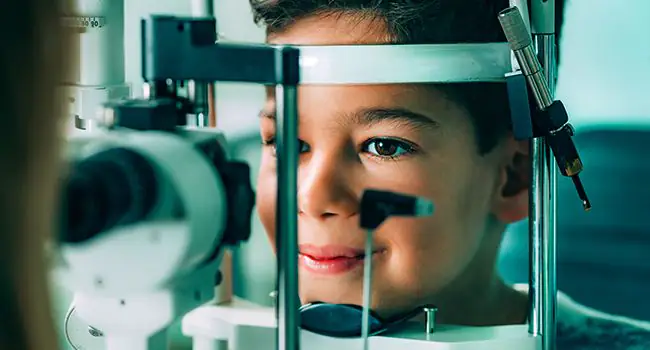
Each evaluation begins with a careful assessment of visual acuity using tests appropriate to the child's age — picture-based tests for younger children, standard chart-based testing for older ones. Eye movement, binocular function, colour vision, and pupil responses are all assessed. A slit-lamp examination of the front of the eye and a dilated examination of the retina, optic nerve, and macula complete the assessment, giving a thorough picture of the child's overall ocular health at that point in their development.
Cycloplegic refraction & refractive error measurement
Measuring refractive error accurately in children requires cycloplegic eye drops to relax the focusing muscle of the eye, allowing the true prescription to be measured without the eye compensating. This step is particularly important in younger children, whose eyes can mask a significant degree of long-sightedness through natural accommodation. The cycloplegic refraction findings determine whether glasses are needed, what prescription is appropriate, and whether there is a meaningful difference in prescription between the two eyes — a key risk factor for amblyopia development if left uncorrected.
Amblyopia & strabismus assessment and management
Amblyopia and strabismus are among the most time-sensitive conditions in pediatric ophthalmology — treatment is most effective during the early years of life when the visual cortex remains responsive. Amblyopia is addressed first through optical correction of any underlying refractive error, with patching or atropine penalisation of the stronger eye introduced where further stimulation of the weaker eye is needed. Strabismus is assessed in terms of type, direction, angle, and consistency, with treatment options ranging from glasses and orthoptic exercises through to surgical correction of the extraocular muscles where indicated.
Myopia management & ongoing review
Myopia in children is increasing in prevalence and, when it progresses to a high degree, carries long-term risks for the health of the eye. Where progression is identified or a child is at elevated risk, a structured myopia management programme is offered, with options tailored to the child's age, current prescription, and rate of change. All children with identified conditions — whether refractive error, amblyopia, strabismus, or anything else — are placed on a follow-up schedule with review intervals suited to the nature and activity of their condition, ensuring any changes are caught promptly.
Early eye care in childhood is one of the most valuable investments in a child's long-term development. Visual difficulties that go unaddressed in the early years can affect reading, learning, coordination, and confidence in ways that persist well into adulthood. At Vinayaka Nethralaya, pediatric eye evaluations are approached with the attention and patience they require, and parents leave with a clear understanding of their child's eye health and what, if anything, needs to be done. Our team has been caring for families across Bengaluru since 1994 and treats every child's vision with the same seriousness we bring to adult ophthalmic care.
What is included
Your child's complete eye care experience at our centre
Questions about pediatric eye evaluation