

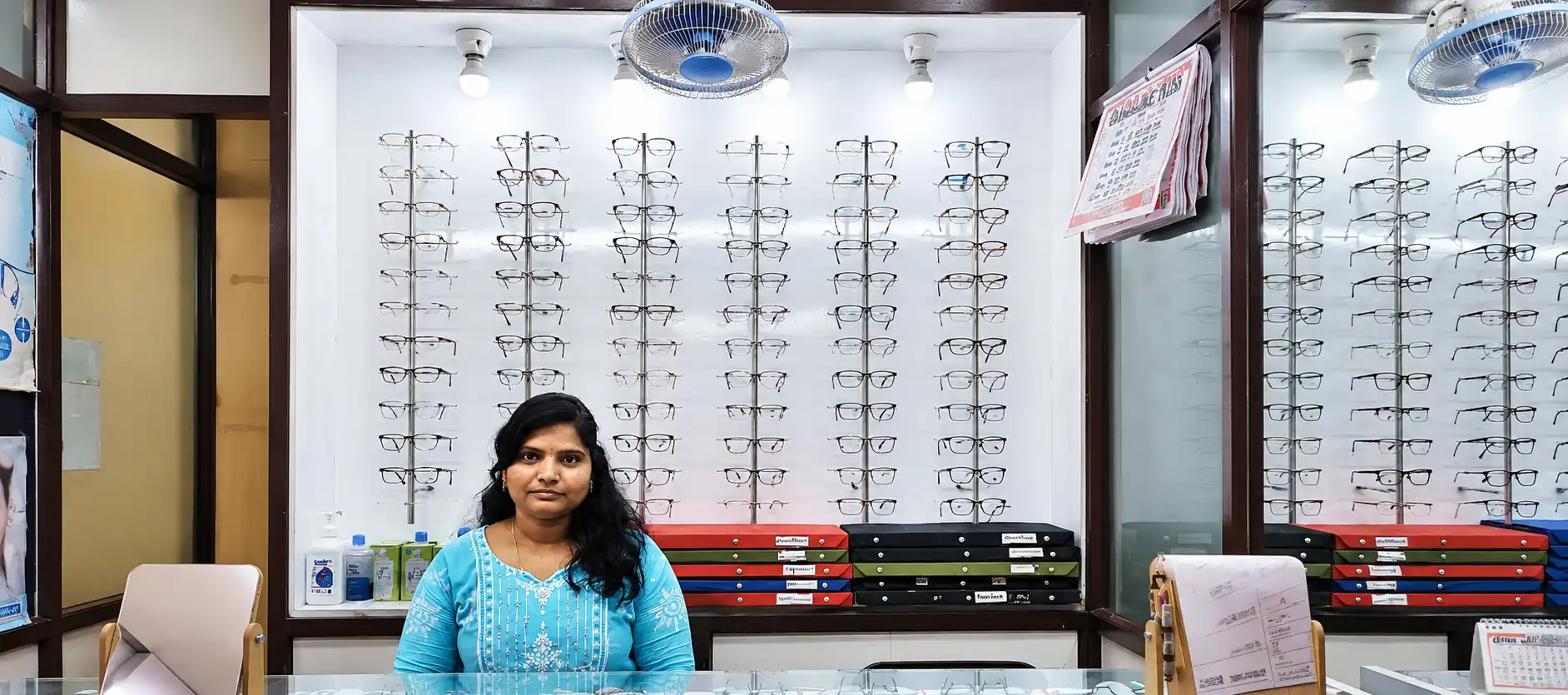
Optical Services at Vinayaka Nethralaya
The right lenses and frames for your vision, fitted with care and precision
Spectacles are more than a vision aid — they are something most wearers put on first thing in the morning and remove last thing at night. Getting them right matters, and that goes well beyond the accuracy of the prescription. The lens design needs to suit the way you use your eyes throughout the day. The frame needs to fit properly and position the lenses correctly in front of each eye. The coatings should address the specific lighting and screen conditions you encounter regularly. At Vinayaka Nethralaya, our in-house optical dispensary provides a complete spectacle service — from prescription verification and lens selection through to frame fitting and follow-up adjustments — with guidance at each step from experienced staff who understand both the clinical and practical aspects of getting the best possible result from your eyewear.
Wide selection of lens designs, materials and optical coatings
Clear, affordable pricing throughout
Optical dispensing guided by experienced ophthalmic staff
Dispensing consultation & visual needs discussion
The dispensing process begins with a conversation about how you use your eyes day to day — your work environment, screen habits, driving, outdoor activities, and any difficulties with your current glasses. Understanding these details allows us to recommend lenses that are genuinely suited to your routine rather than simply matched to your prescription. Patients who have had issues with previous spectacles — whether adaptation difficulties, visual fatigue, or frame comfort — are encouraged to share these experiences so they can be taken into account from the outset.
Lens selection & optical design
Selecting the right lens involves choosing the appropriate design, material, and coatings for your prescription and lifestyle. Single vision lenses correct for one focal distance and suit most straightforward prescriptions. Progressive lenses provide a smooth transition from distance to near vision within a single lens, without a visible dividing line, and are the preferred choice for patients who need correction at multiple distances. For stronger prescriptions, thinner high-index materials reduce bulk and weight considerably. Coatings such as anti-reflection, blue light attenuation, and photochromic treatments are recommended where they would make a meaningful difference to daily comfort and visual clarity.
Frame selection & dispensing measurements
Our frame collection covers a range of styles, sizes, and materials to suit different face shapes and personal preferences. Once a frame is selected, a set of precise measurements is taken — including pupillary distances for each eye individually, fitting heights, and frame angles — to ensure the lenses are manufactured and positioned correctly for your specific facial geometry. These measurements directly affect optical performance, particularly for progressive lenses where the positioning of the reading zone is critical to comfortable use.
Frame fitting, adjustment & aftercare
When your spectacles are ready, a fitting appointment is carried out to check that the frame sits correctly, the lenses are aligned with your eyes, and there are no pressure points on the nose or behind the ears. Patients receiving progressive lenses for the first time are given clear guidance on what to expect during the adaptation period and how to use the different zones of the lens effectively. The team is available for any follow-up adjustments needed in the weeks after collection, and all spectacles can be re-adjusted or fine-tuned at any time as part of our ongoing aftercare.
The optical dispensary at Vinayaka Nethralaya has been serving patients alongside our clinical services since 1994. Every pair of spectacles dispensed here is backed by the same commitment to accuracy and patient satisfaction that defines our ophthalmic practice. Whether you need a straightforward single vision pair, a new set of progressives, or advice on the most suitable lenses for a particular activity or work environment, our team is here to help you find the right solution.
What is included
Your complete optical dispensing experience at our centre
Questions about our optical services